Board Book Printing


Board books are designed for babies, toddlers, and early readers who need books with thick pages, strong structure, and easy page turning. They are commonly used for children’s storybooks, baby books, early learning books, alphabet books, number books, and interactive books.
Common board book sizes include 6″ × 6″, 7″ × 7″, and 8″ × 8″, while page counts are usually arranged in multiples of 2. Many board book projects are produced with 12–32 pages, depending on the story length, artwork, target age group, and book structure.
For board book pages, a common method is to mount two sheets of C1S paper together, such as 250gsm + 250gsm, 300gsm + 300gsm, or 350gsm + 350gsm. The final page thickness depends on the paper weight, mounting process, glue layer, lamination, and surface finish. Board books can also be customized with rounded corners, die-cut shapes, lift-the-flap pages, pop-up structures, and other interactive details based on your project requirements.
For board book printing, paper weight is usually related to the mounted page structure. Unlike regular books, board book pages are often made by mounting two printed C1S sheets together to create a thick, sturdy page. This gives the book better rigidity, durability, and page-turning strength for babies, toddlers, and early readers.
| Paper / Material Type | Common Specification | Suitable For |
|---|---|---|
| C1S Mounted Board Pages | 250gsm + 250gsm C1S paper | Lightweight board books, small-size baby books, cost-conscious projects |
| C1S Mounted Board Pages | 300gsm + 300gsm C1S paper | Standard board books, toddler books, early learning books |
| C1S Mounted Board Pages | 350gsm + 350gsm C1S paper | Thicker board books, premium children’s books, more durable board pages |
| Printed Art Paper for Hardcover Case | 157gsm / 200gsm art paper wrapped over greyboard | Hardcover-style board book covers and premium retail editions |
| Surface Lamination | Matte / gloss / soft touch film | Adds surface protection, improves color effect, and makes pages easier to handle |
In board book production, 350gsm usually refers to one printed C1S sheet before mounting. For example, a 350gsm + 350gsm structure means two sheets are mounted together to form one thick board page. The final page thickness can vary depending on the paper weight, mounting process, glue layer, lamination, and surface finish.
For most standard board book projects, 300gsm + 300gsm or 350gsm + 350gsm C1S paper is commonly used. If the book needs to feel lighter and easier for small children to hold, a lighter mounted structure may be selected. If the project requires a stronger, more premium feel, a thicker mounted structure can be used.
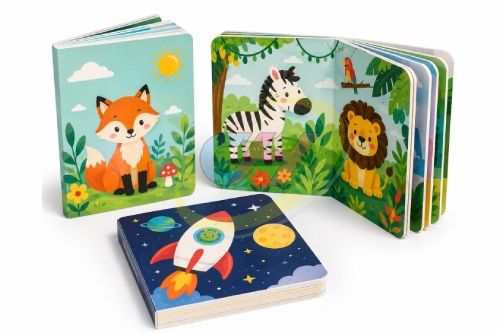
Self-cover board books use the same mounted board structure for both the cover and inner pages, so the whole book has a consistent thickness from front to back. This structure is simple, durable, and cost-effective, making it a common choice for baby books, toddler books, early learning books, alphabet books, number books, and simple storybooks.
The cover and pages can be printed with full-color artwork, finished with matte or gloss lamination, and customized with rounded corners for better handling. Because there is no separate hardcover case, self-cover board books are usually lighter, more compact, and easier for young children to hold while still keeping the thick-page structure.
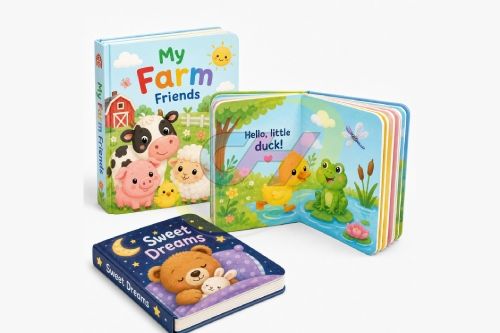
Hardcover board books combine thick mounted board pages with a separate wrapped hardcover case. Compared with self-cover board books, this structure gives the book stronger outside protection, a more stable shape, and a more complete finished appearance.
The hardcover case can be wrapped with printed paper and matched with the inner board pages to create a clean and well-structured book. Inside, the board pages remain thick, sturdy, and easy for children to turn. This format is useful when the project needs stronger cover support, better durability, or a more polished presentation.
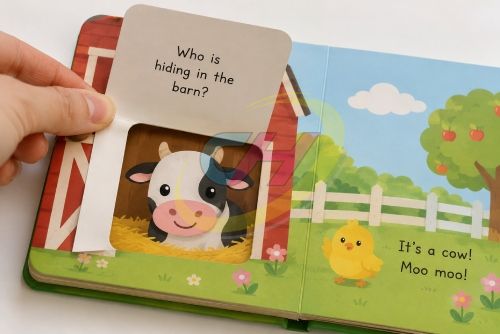
Lift-the-flap board books add interactive flap sections to the pages, allowing children to open hidden areas and discover pictures, words, numbers, animals, or learning content underneath. This makes the reading experience more engaging and encourages children to interact with the book instead of only looking at the pages.
The flap size, shape, position, folding direction, and hidden artwork need to be planned carefully during file preparation. Flaps can be used for early learning, storytelling, question-and-answer pages, object recognition, and simple surprise effects. The final structure should be checked together with the artwork, page thickness, die-cut lines, and production method.
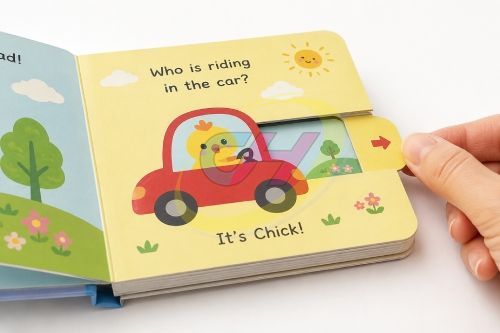
Movable board books use simple mechanical paper structures such as sliders, pull tabs, rotating wheels, or moving panels to create motion on the page. These details can make characters move, objects appear, scenes change, or learning content become more playful.
This type of board book needs more structural planning than a standard board book because each moving part must fit correctly with the page design and die-cut position. The paperboard thickness, movement space, pull direction, and assembly method all need to be considered before production. Movable board books are suitable for projects that need stronger interaction and a more memorable reading experience.
All materials used for custom board book production, including paperboard, ink, glue, lamination, and surface finishing materials, are selected with children’s safety in mind by default. Rounded corners, sturdy page construction, and child-friendly surface treatment also help make the books safer and more durable for babies, toddlers, and young readers.
CPC certification supports board book projects for the US market and helps meet applicable children’s product safety requirements, including ASTM F963 and CPSIA-related standards.
CE / EN71 certification supports board book projects for the European market and helps meet relevant safety requirements for children’s products, materials, and interactive structures.
CPC |
CE certification |
Our standard MOQ is usually 500 copies, depending on the book size, page count, board structure, finishing process, and special features.
The cost depends on size, page count, paper weight, mounting method, surface finish, die-cut shape, interactive structure, quantity, and shipping method. Send us your specifications or artwork, and we will provide a detailed quotation.
Sample production usually takes about 3–7 days after file confirmation. Bulk production normally takes around 10–15 days, depending on quantity, structure, and finishing requirements.
Common board book sizes include 6″ × 6″, 7″ × 7″, and 8″ × 8″. Custom sizes, portrait formats, landscape formats, and shaped books can also be produced based on your artwork.
Many board books are produced with 12–32 pages, depending on the story length, target age group, artwork, and structure. Page counts are usually arranged in multiples of 2.
Board book pages are often made by mounting two sheets of C1S paper together, such as 250gsm + 250gsm, 300gsm + 300gsm, or 350gsm + 350gsm. The final thickness depends on the mounting process, glue layer, lamination, and surface finish.
A self-cover board book uses the same board page structure for both the cover and inner pages. A hardcover board book uses a wrapped hard case cover for a stronger and more premium outer structure.
Yes. Board books can include lift-the-flap pages, die-cut shapes, pop-up structures, touch-and-feel areas, wheels, or sound modules. The final structure needs to be checked based on artwork and production feasibility.
Yes. We can provide a sample or proof before mass production so you can check the board thickness, color, lamination, corner style, binding, and overall structure.


